GSTR-1 vs GSTR-3B: Key Differences Every Business Should Know
GSTR-1 vs GSTR-3B: Key Differences Every Business Should Know
Every regular GST-registered business files two core monthly (or quarterly) returns — GSTR-1 and GSTR-3B — and it's common to assume they're reporting the same information twice. They're not. They serve different purposes, follow different due dates, and a mismatch between the two is one of the most common triggers for a GST notice.
This guide breaks down exactly what each return covers, how they differ, and why keeping them consistent matters more than most businesses realize.
What Is GSTR-1?
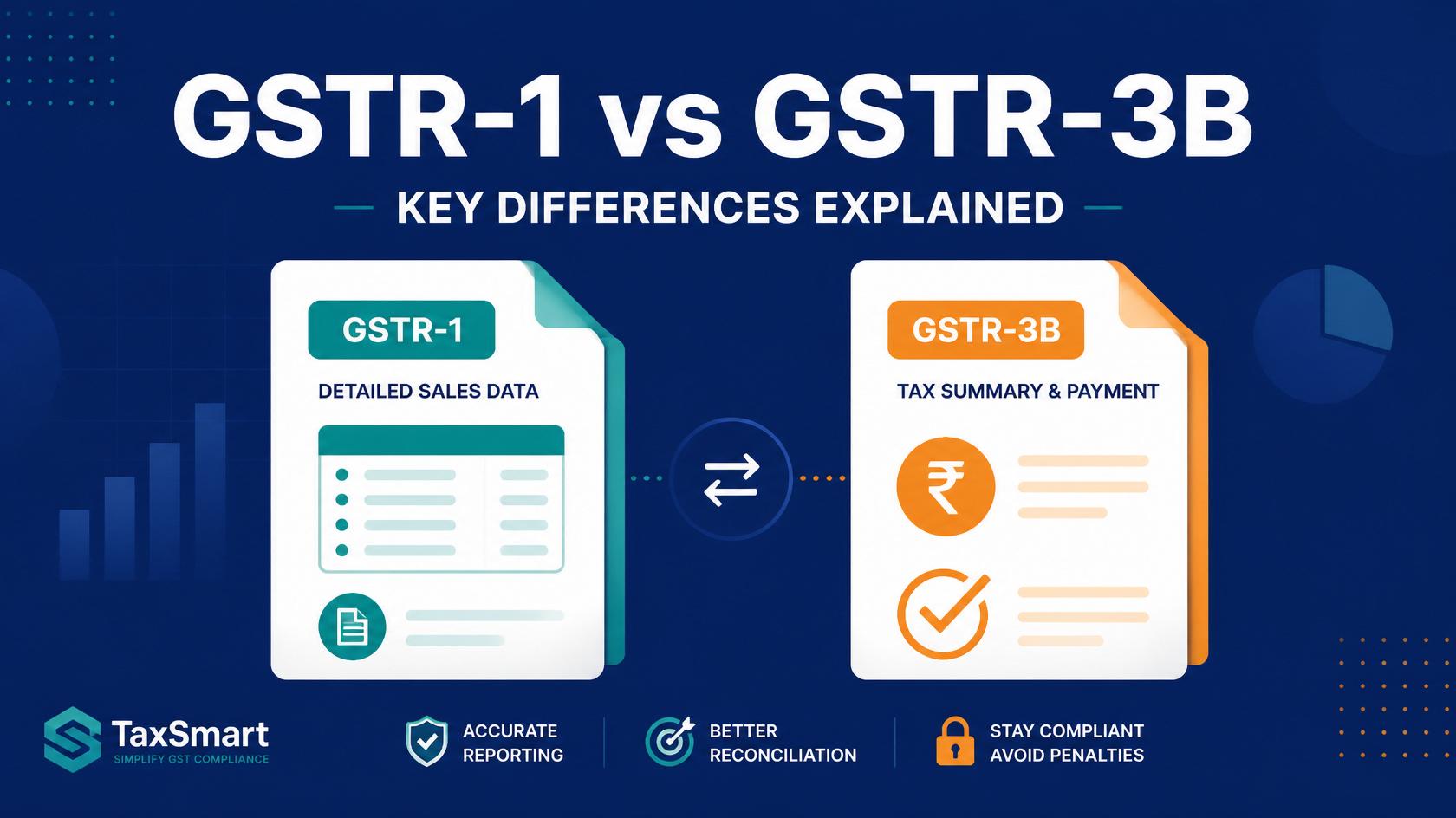
GSTR-1 is a statement of outward supplies — it reports invoice-level details of every sale a business has made during the period. This includes B2B and B2C invoices, credit and debit notes, exports, and amendments to previously reported invoices.
GSTR-1 is where your sales data actually originates in the GST system. It's this return that populates your buyers' GSTR-2B, which means any error or delay here has a direct downstream effect on your customers' ability to claim Input Tax Credit.
What Is GSTR-3B?
GSTR-3B is a self-declared summary return — it reports consolidated totals of sales, Input Tax Credit claimed, and net GST liability for the period. Unlike GSTR-1, it doesn't require invoice-level detail; it's a summary used primarily to calculate and pay actual tax.
GSTR-3B is also the return through which tax payment happens. Even if GSTR-1 has been filed correctly, the liability isn't settled until GSTR-3B is filed and the corresponding tax is paid.
Key Differences Between GSTR-1 and GSTR-3B
Factor | GSTR-1 | GSTR-3B |
|---|---|---|
Purpose | Reports outward supplies (sales) in invoice-level detail | Summary return for tax calculation and payment |
Level of detail | Invoice-wise (each sale listed individually) | Consolidated totals only |
Tax payment | No tax is paid through this return | Tax liability is paid when this return is filed |
Who it affects downstream | Populates buyers' GSTR-2B, directly affecting their ITC | Affects your own tax ledger and compliance status |
Due date (monthly filers) | 11th of the following month | 20th of the following month |
Due date (QRMP filers) | 13th of the month after the quarter (IFF optional monthly) | 22nd or 24th of the month after the quarter, by state category |
Can it be revised? | Not directly; corrections made via amendments in a later period's GSTR-1 | Not directly; correction handled through adjustments in subsequent returns |
What it's based on | Your own sales records and invoices issued | Your GSTR-1 data plus GSTR-2B-based ITC claims |
Late filing consequence | Delays buyer's ITC eligibility via GSTR-2B | Late fee and interest on unpaid tax |
Nil filing required? | Yes, even with no sales during the period | Yes, even with no transactions during the period |
Why the Two Returns Need to Match
GSTR-3B isn't filed in isolation — its sales and tax figures are expected to reconcile with what was already reported in GSTR-1 for the same period. When the two don't align, it creates a red flag in the GST system.
Common causes of GSTR-1 vs. GSTR-3B mismatches:
Sales reported in GSTR-1 but the corresponding tax not reflected in GSTR-3B
Amendments made in GSTR-1 for an earlier period that aren't carried through consistently in GSTR-3B
Data entry errors when summarizing invoice-level GSTR-1 data into GSTR-3B's consolidated figures
Timing differences, where an invoice is reported in one period's GSTR-1 but its liability appears in a different period's GSTR-3B
Why this matters: The GST department runs automated matching between GSTR-1 and GSTR-3B figures. A persistent or significant mismatch is one of the most common triggers for a scrutiny notice, since it suggests either underreported tax liability or inconsistent record-keeping.
How GSTR-1 Affects Your Buyers' ITC
This is the part that's easy to overlook if you're only thinking about your own compliance. When you file GSTR-1, your reported sales invoices flow into your buyers' GSTR-2B — the statement they use to claim ITC. If your GSTR-1 is filed late, filed with errors, or contains missing invoices, it directly delays or blocks ITC for every business that purchased from you during that period.
This is why GSTR-1 accuracy isn't just an internal compliance matter — it has a direct reputational and relationship impact on your business's vendors and buyers.
Filing Sequence: Which Comes First?
GSTR-1 is due before GSTR-3B in each filing cycle (11th vs. 20th for monthly filers), and this sequence matters. Filing GSTR-1 first, and reviewing it before filing GSTR-3B, gives you the chance to make sure your GSTR-3B summary figures actually reflect what was reported invoice-wise, rather than relying on a rushed, separate calculation.
Common Mistakes Businesses Make With These Two Returns
Treating GSTR-3B as the "real" return and GSTR-1 as an afterthought — since GSTR-1 doesn't involve tax payment, it's sometimes filed carelessly, but its accuracy directly affects buyers' ITC and your own audit trail
Not reconciling GSTR-1 and GSTR-3B figures before filing — leading to mismatches that surface months later as scrutiny notices
Forgetting Nil filing obligations — both returns require filing even with zero transactions in a period
Missing amendment windows — errors in an earlier GSTR-1 need to be corrected through amendments in a subsequent period's return, and delaying this compounds reconciliation issues later
Final Thoughts
GSTR-1 and GSTR-3B aren't two versions of the same filing — one reports what you sold, invoice by invoice, and the other summarizes your tax position and settles payment. Treating them as connected, sequential steps rather than separate, independent tasks is what keeps your GST compliance consistent and avoids the mismatch notices that come from filing them in isolation.
Frequently Asked Questions
Q:Is GSTR-1 more important than GSTR-3B, or vice versa?
Neither is more important — they serve different purposes. GSTR-1 reports invoice-level sales data that affects your buyers' ITC, while GSTR-3B is the return through which you actually calculate and pay tax. Both need to be filed accurately and on time.
Q:Do I need to pay tax when filing GSTR-1?
No. GSTR-1 only reports sales details; it doesn't involve any tax payment. Tax liability is calculated and paid when GSTR-3B is filed.
Q:What happens if GSTR-1 and GSTR-3B figures don't match?
A mismatch between the two returns is a common trigger for GST scrutiny notices, since the department's automated systems compare these figures for consistency. Significant or repeated mismatches can lead to a demand notice requiring explanation or additional tax payment.
Q:Can I file GSTR-3B before GSTR-1?
GSTR-1 is generally due before GSTR-3B in each filing cycle, and reviewing GSTR-1 first helps ensure your GSTR-3B summary accurately reflects your invoice-level sales data.
Q:Is Nil filing required for both returns?
Yes. Both GSTR-1 and GSTR-3B must be filed even for periods with zero sales or transactions — skipping Nil filing still results in late fees.
Q:Can I revise or correct GSTR-1 after filing?
GSTR-1 cannot be directly revised. Corrections to previously reported invoices are made through amendment entries in a subsequent period's GSTR-1.
Q:How does GSTR-1 affect my customers' Input Tax Credit?
The invoices you report in GSTR-1 populate your buyers' GSTR-2B statement, which they use to claim ITC. Late or inaccurate GSTR-1 filing directly delays or reduces your buyers' eligible ITC for that period.
Q:What is the due date difference between GSTR-1 and GSTR-3B for monthly filers?
For monthly filers, GSTR-1 is due on the 11th of the following month, while GSTR-3B is due on the 20th of the following month.
Q:Do QRMP quarterly filers file GSTR-1 quarterly too?
Yes, QRMP filers can file GSTR-1 quarterly, though they have the option to use the Invoice Furnishing Facility (IFF) to report B2B invoices monthly even while filing the main GSTR-1 quarterly.
Q:Why do CA firms emphasize reconciling GSTR-1 and GSTR-3B before filing?
Because the two returns are cross-checked by the GST system, and unreconciled figures between them are one of the most common, avoidable causes of scrutiny notices — catching mismatches before filing is far simpler than responding to a notice afterward.