GST Compliance Workflow Template for CA Firms (Free Checklist 2026)
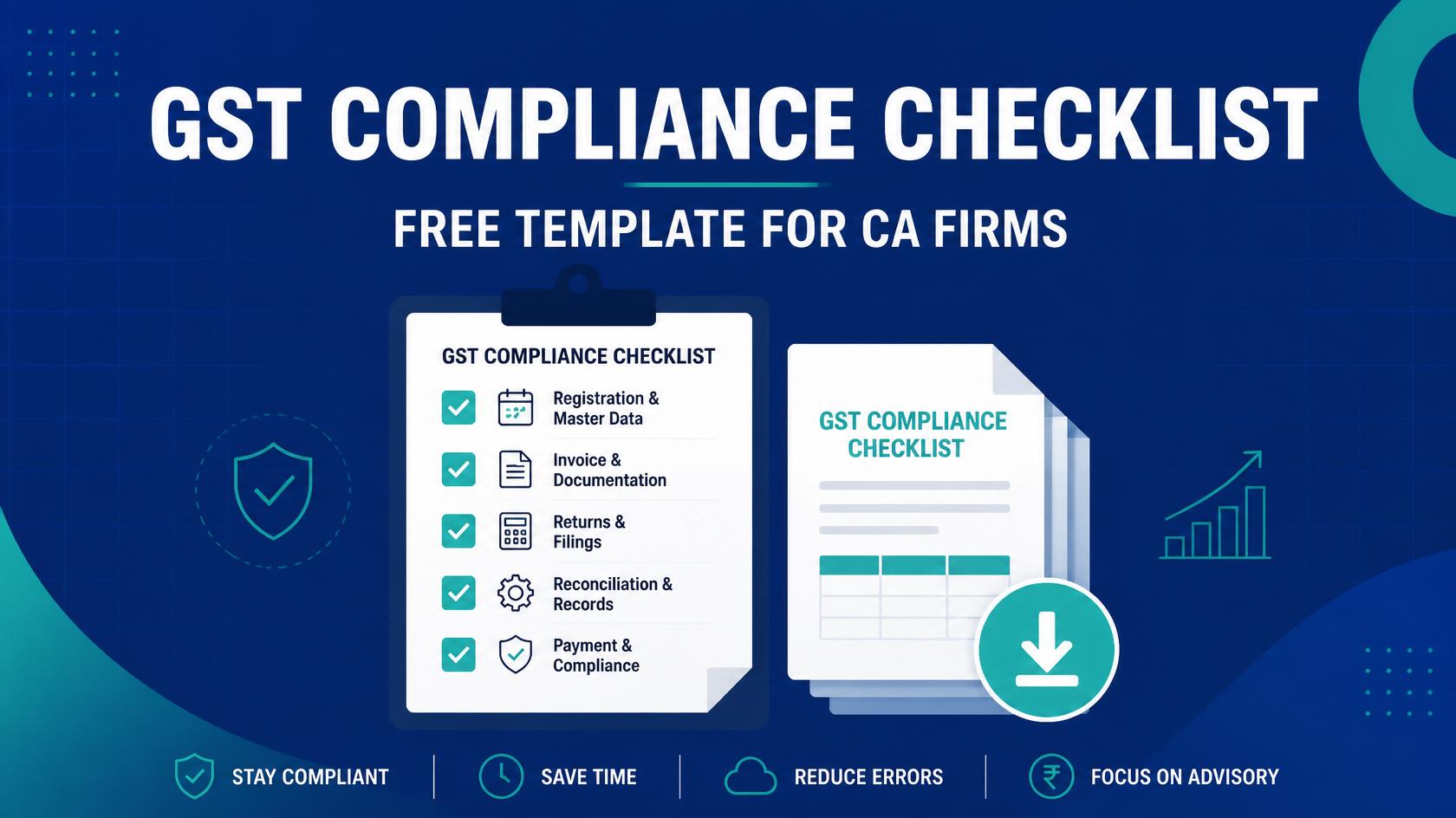
GST Compliance Workflow Template for CA Firms (Free Checklist)
Every CA firm ends up building its own version of a GST compliance workflow eventually — usually pieced together over time, spread across spreadsheets, WhatsApp reminders, and whatever a senior team member remembers to check. It works, until it doesn't: a missed reconciliation step, a client's GSTIN quietly getting suspended, or a due date mix-up across QRMP and monthly clients.
This post lays out a complete, repeatable monthly GST compliance workflow you can adopt as-is or adapt to your firm — plus a free downloadable checklist template at the end.
Why CA Firms Need a Standardized Workflow
When compliance work is scattered across individual habits rather than a documented process, three things tend to go wrong as a firm scales:
Inconsistency across clients — one team member's thorough process doesn't automatically transfer to how a junior associate handles a different client's filings
Missed steps under deadline pressure — reconciliation and verification steps are the first things skipped when a filing deadline is close, which is exactly when they matter most
No audit trail — if a client or a GST officer asks how a reconciliation was handled six months later, an undocumented, ad hoc process is hard to reconstruct
A standardized workflow fixes all three — not by adding more work, but by making sure the same essential steps happen for every client, every cycle, regardless of who's handling it.

The Monthly GST Compliance Workflow
Step 1: Verify Client GSTIN Status
Before any filing work begins for the period, confirm the client's GSTIN is still active and check their return filing history. A GSTIN can show "Active" while consistently failing to file, which affects downstream ITC. This step also matters for your client's vendors — if you're doing purchase-side reconciliation, verifying supplier GSTIN status is equally important before accepting ITC on their invoices.
Step 2: Download GSTR-2B for the Period
Pull the client's GSTR-2B for the relevant tax period. Note whether the client is on QRMP or monthly filing, since this affects which period's GSTR-2B is relevant and when it needs to be reviewed — QRMP clients need this checked monthly even though filing itself happens quarterly. For a full breakdown of QRMP-specific timing, see the complete guide to GSTR-3B due dates for QRMP filers.
Step 3: Reconcile GSTR-2B Against the Purchase Register
Match every invoice in the client's purchase register against GSTR-2B — flagging missing invoices, value mismatches, and duplicates. This is typically the most time-consuming manual step in the entire workflow, and the one most prone to error when done through spreadsheet formulas alone.
Step 4: Review and Resolve Flagged Mismatches
For every flagged discrepancy, determine the cause — supplier filing delay, data entry error, or genuine issue — and follow up with the client or supplier accordingly. Document the resolution for each flagged item rather than just clearing it from the sheet.
Step 5: Cross-Check GSTR-1 Against GSTR-3B Before Filing
Before filing GSTR-3B, confirm its summary figures are consistent with what was already reported in GSTR-1 for the period. Mismatches between the two are a common trigger for scrutiny notices — see GSTR-1 vs GSTR-3B: Key Differences for a full breakdown of how the two returns relate.
Step 6: Confirm Due Dates Before Filing
Verify the exact due date applicable to the client — monthly filers, and QRMP filers split further by Category X or Category Y state. Mixing these up across a multi-client, multi-state portfolio is a common, avoidable error. Keep the complete GSTR-3B filing calendar handy as a standing reference for the firm.
Step 7: File and Pay
File GSTR-3B (or confirm PMT-06 payment for QRMP clients in non-filing months) and retain the acknowledgment and payment challan in the client's file.
Step 8: Document and Archive
Save the reconciliation working file, mismatch resolution notes, and filing acknowledgment together for each client, each period. This becomes the audit trail that protects both your firm and the client if questions come up later.
Monthly GST Compliance Checklist
# | Task | Frequency | Responsible |
|---|---|---|---|
1 | Verify client GSTIN status and filing history | Monthly | Article clerk / associate |
2 | Download GSTR-2B for the period | Monthly (QRMP clients too) | Article clerk / associate |
3 | Reconcile GSTR-2B vs. purchase register | Monthly | Associate |
4 | Investigate and resolve flagged mismatches | Monthly | Associate / senior review |
5 | Cross-check GSTR-1 vs. GSTR-3B figures | Before each filing | Senior associate |
6 | Confirm applicable due date (monthly/QRMP, state category) | Before each filing | Associate |
7 | File GSTR-3B / confirm PMT-06 payment | On due date | Partner / senior associate sign-off |
8 | Archive reconciliation file, notes, and acknowledgment | After filing | Article clerk / associate |
Where Manual Workflows Typically Break Down
Even with a documented checklist, Steps 1 through 4 remain the bottleneck for most firms — GSTIN verification and GSTR-2B reconciliation done manually, client by client, invoice by invoice, every single month. This is where firms managing more than a handful of clients start to feel the workflow strain most, since these steps don't get faster just because they're documented; they still take the same hours per client each cycle.
If your firm wants to see what a faster, automated version of Steps 1–4 looks like without committing to anything, TaxSolver's free offline reconciliation tool lets you reconcile GSTR-2B against a purchase register directly, without changing your existing workflow.
Download the Free GST Compliance Checklist
We've put this entire workflow into a ready-to-use checklist template your team can print, share, or adapt into your firm's own SOP — covering all 8 steps above with space for client name, period, and sign-off at each stage.
[Enter your email below to get the free checklist template delivered to your inbox →]
Final Thoughts
A documented compliance workflow doesn't eliminate the work involved in GST reconciliation and filing — but it does eliminate the inconsistency, the missed steps under deadline pressure, and the lack of an audit trail that come from an undocumented, person-dependent process. Standardizing it once means every client gets the same level of diligence, regardless of who on the team is handling their filing that month.
Written by Author
Tax VerifiedPublished by the TaxSolver editorial and compliance research group. All guidelines and tax calculations are reviewed against CBIC statutory notifications and CGST Act rules.
Frequently Asked Questions
Q:Why do CA firms need a standardized GST compliance workflow?
A standardized workflow ensures every client receives consistent handling regardless of which team member is assigned, reduces the risk of skipped steps under deadline pressure, and creates a documented audit trail for each filing period.
Q:What's the most time-consuming step in GST compliance for CA firms?
GSTR-2B reconciliation against the purchase register is typically the most time-consuming manual step, especially for firms managing multiple clients each month, since it involves invoice-level matching that doesn't get faster with volume unless it's automated.
Q:How often should GSTIN status be verified for clients?
Ideally every month, before reconciliation begins — a GSTIN can show "Active" status while the taxpayer has stopped filing returns, which directly affects ITC eligibility for that period.
Q:Why does GSTR-1 need to be checked against GSTR-3B before filing?
The GST department cross-checks figures between the two returns, and unresolved mismatches are a common trigger for scrutiny notices. Reviewing consistency before filing catches these issues while they're still easy to fix.
Q:Is this checklist suitable for firms with QRMP clients?
Yes — the checklist explicitly accounts for QRMP clients, who still require monthly GSTR-2B reconciliation and PMT-06 payment tracking even though their GSTR-3B filing itself happens quarterly.
Q:Can this workflow be used for a solo practice, not just a firm with staff?
Yes. While the "Responsible" column reflects a typical firm structure, a solo practitioner can use the same 8 steps as a personal checklist to ensure nothing gets skipped across multiple clients.
Q:Does automating reconciliation replace the need for this checklist?
No — automation speeds up specific steps like GSTIN verification and GSTR-2B matching, but the overall workflow (review, filing, documentation) still benefits from being standardized and followed consistently, regardless of which tools are used within it.
Q:Is the checklist template customizable?
Yes, it's designed as a starting template. Firms typically adapt it slightly to reflect their own internal review and sign-off structure once they've used it for a cycle or two.