GSP vs Direct GSTN Integration: What SMBs Should Know (2026)
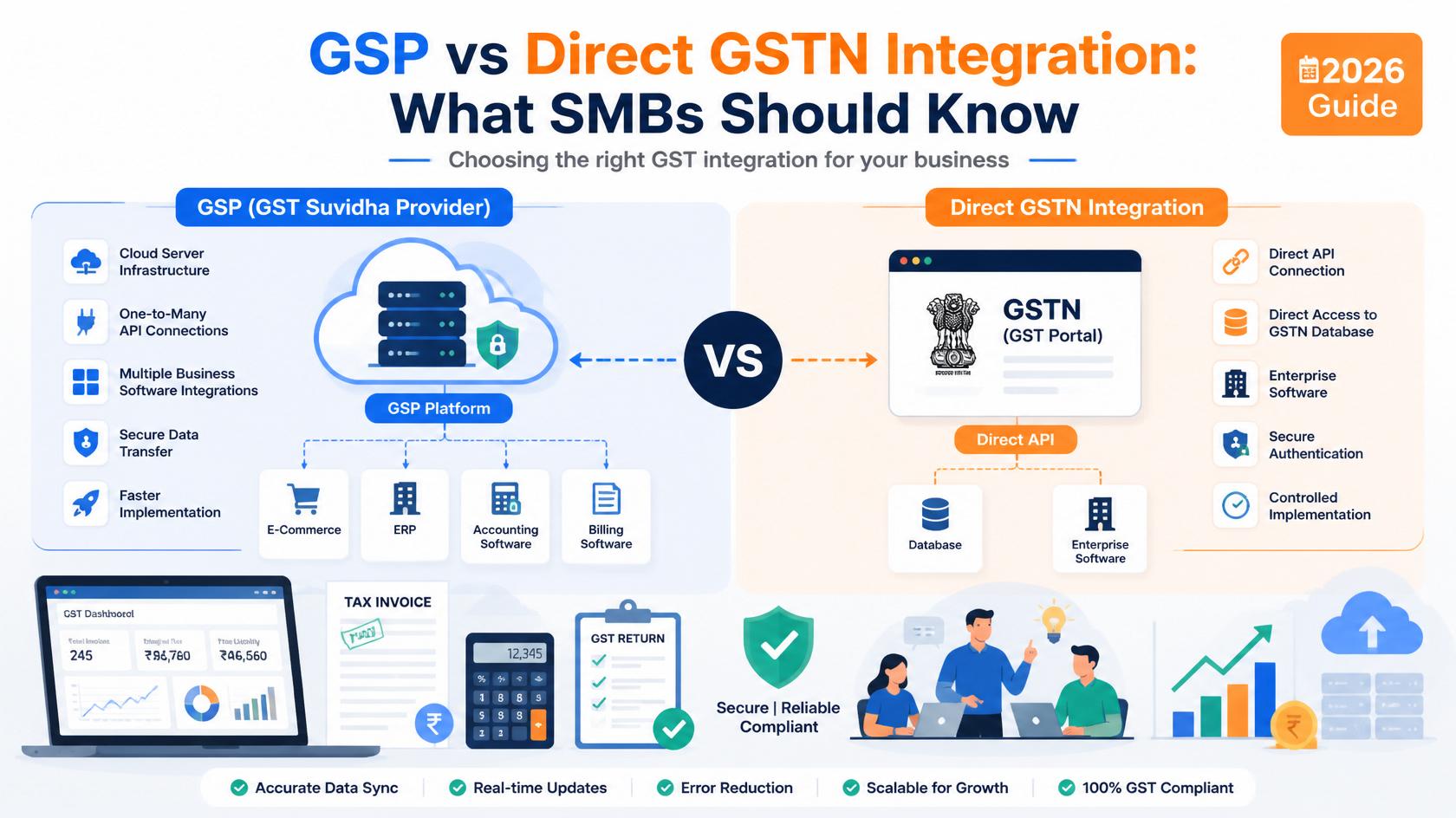
GSP vs Direct GSTN Integration: What SMBs Should Know
If you're building or buying software that needs to talk to the GST system — fetching GSTR-2B, verifying GSTINs, or pulling e-invoice data — you'll eventually run into a decision point: connect directly to GSTN, or go through a GST Suvidha Provider (GSP).
For SMBs and CA firms without a dedicated compliance engineering team, this decision affects development time, reliability, and cost far more than it might seem at first glance. This guide breaks down what each option actually involves, so you can choose the right one without learning it the hard way.
What Is GSTN, and What Does "Direct Integration" Mean?
GSTN (Goods and Services Tax Network) is the backbone IT infrastructure that powers India's GST system — it processes returns, invoices, and registrant data across the country. Technically, businesses can integrate directly with GSTN's APIs to build their own compliance tools.
In practice, direct GSTN access is tightly controlled. It's primarily available to GSPs and select large enterprises that meet GSTN's technical, security, and volume requirements. For most SMBs and independent software builders, direct GSTN integration isn't a straightforward option — it involves a lengthy approval process, strict compliance requirements, and infrastructure standards that are hard to justify unless you're operating at very large scale.
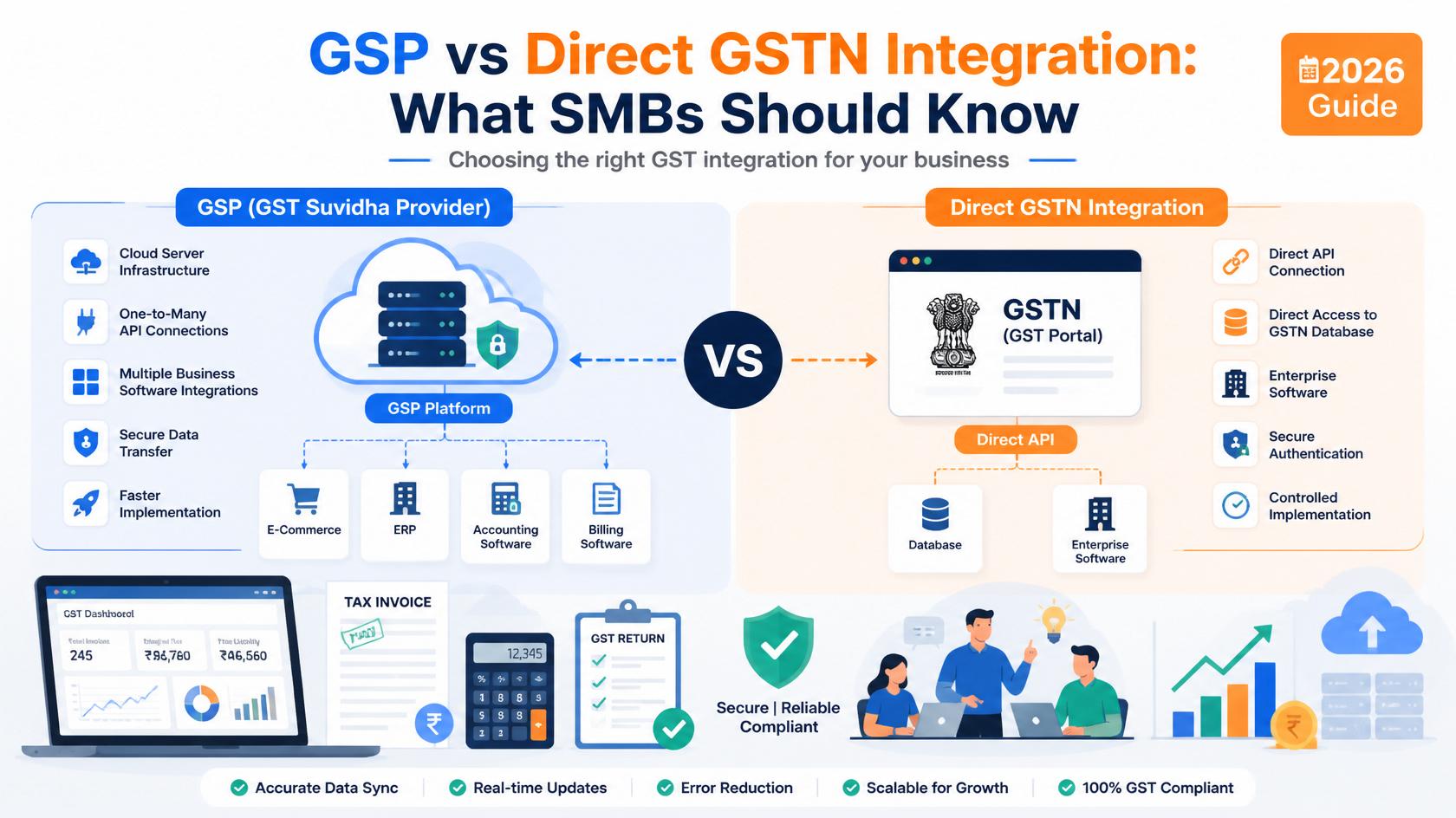
What Is a GSP, and How Does It Fit In?
A GST Suvidha Provider (GSP) is a company authorized by GSTN to provide GST-related services to taxpayers and software providers through a simplified API layer. GSPs handle the direct GSTN relationship, security compliance, and infrastructure — and expose a cleaner, developer-friendly API on top of it.
Instead of dealing with GSTN's raw infrastructure, businesses and software providers integrate with a GSP's API to access services like:
GSTR-2B and GSTR-2A data retrieval
GSTIN verification
E-invoice generation and validation
Return filing status checks
This is the model TaxSolver uses — integrating with Sandbox.co.in as the GSP intermediary to fetch GSTR-2B data and verify GSTINs, rather than pursuing direct GSTN access.
Why Most SMBs Should Not Attempt Direct GSTN Integration
On paper, direct integration sounds like it removes a middleman and potentially reduces cost. In practice, for SMBs and smaller software teams, it usually creates more problems than it solves.
Approval and eligibility barriers. Direct GSTN access requires meeting eligibility criteria that are largely designed for GSPs and large enterprises — including infrastructure security audits, minimum technical capability requirements, and a formal approval process that can take months.
Infrastructure and compliance overhead. Even after approval, direct integrators are responsible for maintaining the security, uptime, and compliance standards GSTN requires on an ongoing basis — essentially becoming a mini-GSP themselves, without the commercial ecosystem a GSP already has in place.
No abstraction layer. GSTN's raw APIs are built for infrastructure-level access, not application-level convenience. Every format quirk, versioning change, or edge case in GSTN's system has to be handled directly, rather than through a GSP's already-normalized interface.
Slower time to market. For an SMB or solo founder trying to ship a product, the months spent on direct GSTN approval and infrastructure work is time not spent building the actual product.
Why the GSP Route Makes Sense for SMBs
Faster integration. GSPs like Sandbox.co.in expose REST APIs with clear documentation, sandbox environments for testing, and straightforward authentication — integration that would take months through direct access can often be done in days or weeks.
Lower infrastructure burden. The GSP handles the underlying GSTN relationship, security certification, and infrastructure scaling. The integrating business only needs to manage its own application layer.
Predictable, usage-based cost. Most GSPs offer pricing based on API calls or subscription tiers, which scales naturally with business size — a much more predictable cost structure for an SMB than building and maintaining direct infrastructure.
Built-in reliability. GSPs are accountable to GSTN for uptime and data accuracy, and typically offer better support and monitoring than a smaller team could realistically build and maintain on their own.
Focus stays on the product. For a company like TaxSolver, the actual value being built is the reconciliation and matching logic — not GST infrastructure plumbing. Using a GSP means engineering time goes toward the product's core differentiation instead of undifferentiated infrastructure work.
GSP vs Direct GSTN Integration: Comparison Table
Factor | GSP Integration | Direct GSTN Integration |
|---|---|---|
Eligibility | Open to most businesses via commercial agreement | Restricted; requires meeting GSTN's technical and security criteria |
Setup time | Days to a few weeks, using documented REST APIs | Months, including approval and infrastructure buildout |
Infrastructure responsibility | Handled by the GSP | Falls entirely on the integrating business |
Compliance and security burden | Managed by the GSP as part of its GSTN authorization | Must be built and maintained in-house |
Cost structure | Usage-based or subscription pricing | High upfront infrastructure and compliance investment |
API abstraction | Clean, developer-friendly endpoints | Raw, infrastructure-level access with more edge cases to handle |
Support and documentation | Dedicated developer support and sandbox environments | Limited to GSTN's own documentation and processes |
Best suited for | SMBs, CA firms, and software builders needing GST data access | Large enterprises or GSPs themselves, operating at significant scale |
Time to first working integration | Fast — days to weeks | Slow — months, if approval is granted at all |
Ongoing maintenance | Largely the GSP's responsibility | Requires a dedicated internal team |
When Might Direct Integration Make Sense?
Direct GSTN integration is realistically only worth pursuing for organizations operating at massive scale — large enterprises processing extremely high volumes of GST transactions, or companies intending to become GSPs themselves and serve other businesses. For the vast majority of SMBs, CA firms, and product teams building GST-adjacent tools, the infrastructure investment simply doesn't pay off compared to the speed and simplicity of working through a GSP.
Final Thoughts
For SMBs and CA firms, the choice between GSP and direct GSTN integration usually isn't a close call. Going through a GSP means faster development, lower infrastructure burden, predictable costs, and the ability to focus engineering effort on what actually differentiates the product — not on becoming a GST infrastructure provider by accident. This is exactly why TaxSolver is built on top of a GSP integration with Sandbox.co.in, rather than pursuing direct GSTN access: it lets the product focus on solving reconciliation, not on rebuilding infrastructure that already exists.
Frequently Asked Questions
Q:What is a GSP in GST terminology?
A GST Suvidha Provider (GSP) is a company authorized by GSTN to offer GST-related services to taxpayers and software providers through a simplified API layer, handling the underlying GSTN relationship, security compliance, and infrastructure on behalf of businesses that integrate with it.
Q:Can any business integrate directly with GSTN?
No. Direct GSTN integration is restricted and primarily available to GSPs and large enterprises that meet GSTN's technical, security, and volume requirements. Most SMBs and smaller software teams access GST data through a GSP instead.
Q:Is it cheaper to integrate directly with GSTN instead of using a GSP?
Not usually, for SMBs. While a GSP involves usage-based or subscription fees, direct integration requires significant upfront investment in infrastructure, security compliance, and ongoing maintenance — costs that typically outweigh GSP fees unless operating at very large scale.
Q:How long does it take to integrate with a GSP compared to GSTN directly?
GSP integration, using documented REST APIs and sandbox environments, can often be completed in days to a few weeks. Direct GSTN integration typically takes months, including the approval process and infrastructure buildout.
Q:What services can a GSP provide access to?
Common GSP services include GSTR-2B and GSTR-2A data retrieval, GSTIN verification, e-invoice generation and validation, and return filing status checks — all accessed through the GSP's API rather than GSTN's raw infrastructure.
Q:Is using a GSP secure and compliant?
Yes. GSPs are authorized by GSTN and are required to meet security and compliance standards as part of that authorization, which is part of why they can offer this access to other businesses in the first place.
Q:Why did TaxSolver choose a GSP instead of direct GSTN integration?
Using a GSP like Sandbox.co.in allows TaxSolver to access GSTR-2B and GSTIN verification data quickly and reliably, without the months of infrastructure and compliance work direct GSTN integration would require — keeping engineering focus on the reconciliation product itself.
Q:Do GSPs offer the same data as GSTN directly?
Yes. GSPs are built on top of GSTN's infrastructure and provide access to the same underlying data, typically through cleaner, more developer-friendly APIs than GSTN's raw endpoints.